
OCR
PaddleOCR attaches text and bounding-box origins to each page.
01 Overview
DocILE is a public benchmark for key information localization and extraction over business documents. For this evaluation, each system received the same PDF input and the same 55-field extraction schema. xMentium's complete-pipeline achieved the highest outcome-weighted field extraction score on the evaluated set: 75.0, compared with 69.9 for the document extraction provider and 69.7 for the strongest frontier LLM baseline.
Validation subset drawn from the DocILE annotated corpus. Document mix: 68% tax invoices, 21% order forms, 4% sales orders, 4% receipts, 2% purchase orders, plus one proforma and one credit note.
02 The Dataset
We reviewed several public extraction datasets before selecting DocILE. The alternatives were either too narrow, too small, too synthetic, primarily diagram-oriented, or too heterogeneous in length to support a stable comparison. DocILE offered the strongest combination of scale, document realism, fixed schema, and layout diversity.
Shop receipts with limited document variety.
Scanned forms, but only 199 documents.
Synthetic invoices with comparatively clean layouts.
Engineering drawings rather than document metadata extraction.
Engineering diagrams, but too clean to stress practical extraction failures.
Long table-heavy PDFs with document lengths ranging from 22 to 11,622 pages.
DocILE contains real business documents rather than synthetic or cleaned-up samples, and its fixed 55-field schema supports consistent system-to-system comparison. Its 1,000+ layout clusters also reduce the risk that a system is being evaluated only on template memorization.
03 Evaluation Protocol
All non-xMentium comparator systems were evaluated through the same benchmark harness. Each runner received the same document bytes, the same extraction schema, the same system instruction, and the same downstream canonicalizer and scorer.
Every provider receives the exact same JSON schema, with descriptions taken verbatim from the dataset. No rewriting descriptions to be more extraction-friendly for one provider.
Every runner uses the shared "You are extracting structured fields from a business document..." prompt. No provider-specific coaching.
No worked examples are included in any prompt. Every provider sees the schema and the PDF, nothing else.
One structured-output call per document. No self-critique loops, retry-on-low-confidence, or iterative refinement. Native multi-pass reasoning inside a provider's own endpoint counts as part of the provider; we add no passes on top.
The schema is preprocessed exactly once, and the identical result is handed to every runner. No provider-specific schema tweaks.
Predictions and ground truth are canonicalized with the same rules that produced the ground truth itself. Providers are scored on extracted content, not on formatting.
Any variant whose cleanup, filter, or normalization rules were derived from measuring failures on the same 500 documents is excluded from the ranked table, even if it scores well.
04 xMentium System
The xMentium row reports a five-stage xADL pipeline built for the DocILE extraction task. It combines OCR, OCR repair, structured VLM extraction, deterministic normalization, and export into the DocILE schema. The pipeline uses invoice-domain field descriptions and prompt rules, but it does not use per-document tuning or worked examples.
PaddleOCR attaches text and bounding-box origins to each page.
A fast vision model cleans OCR text into reading order and repairs common character errors.
A structured-output VLM call receives the page image, repaired OCR text, field descriptions, and invoice-domain extraction rules.
Per-page outputs are consolidated, line items are deduplicated, and amounts, dates, and currencies are canonicalized.
The flat extraction record is projected into the nested 55-field DocILE schema for scoring.
The reported xMentium cost is metered LLM spend for the pipeline: local PaddleOCR, a Luna OCR-repair pass, a Terra extraction pass, and non-LLM normalization/export stages.
05 Scoring
The evaluation scores extracted field values rather than bounding-box localization. Predictions and ground truth are canonicalized with the same rules, then each document-field cell is assigned to one of five outcomes. The same scorer is applied to every system.
mnwmieF = (5m + 0.25n) / (5m + 0.25n + 2mi + 2.5e)Wrong values receive no positive credit in the numerator. They are still reported as a distinct failure class so that value errors, omissions, and over-emissions remain separable in analysis.
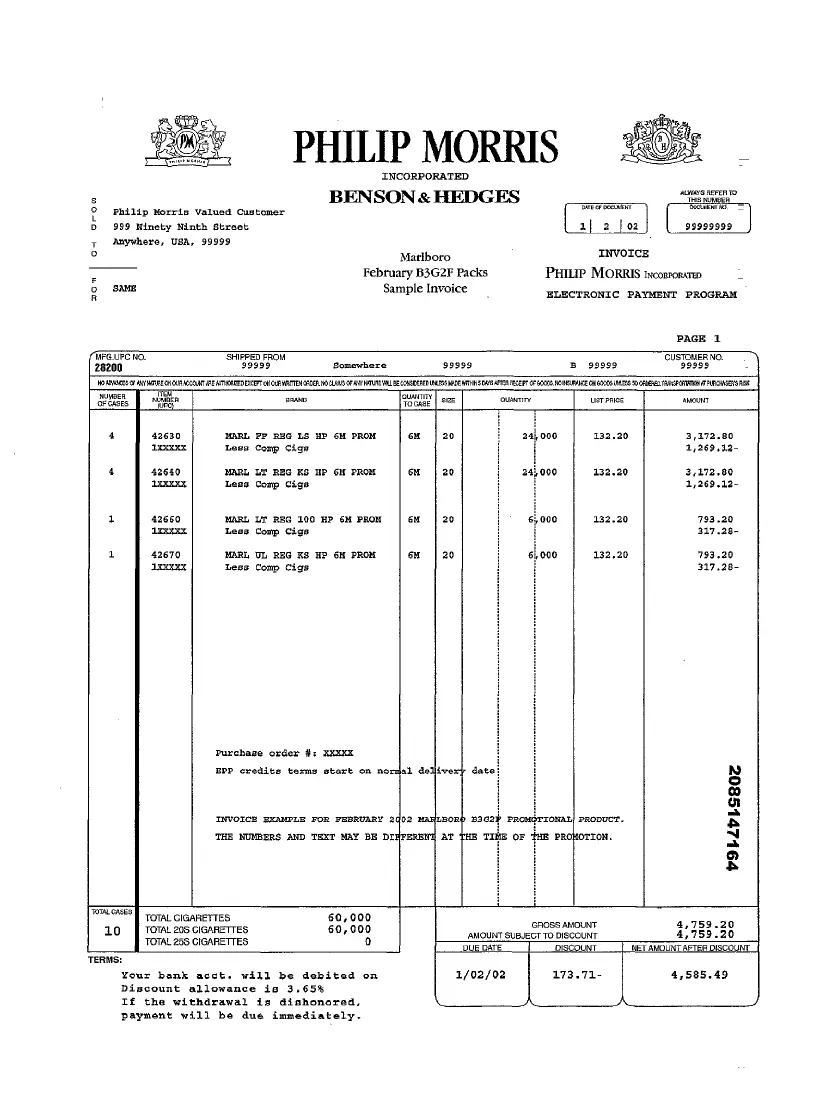
Original document
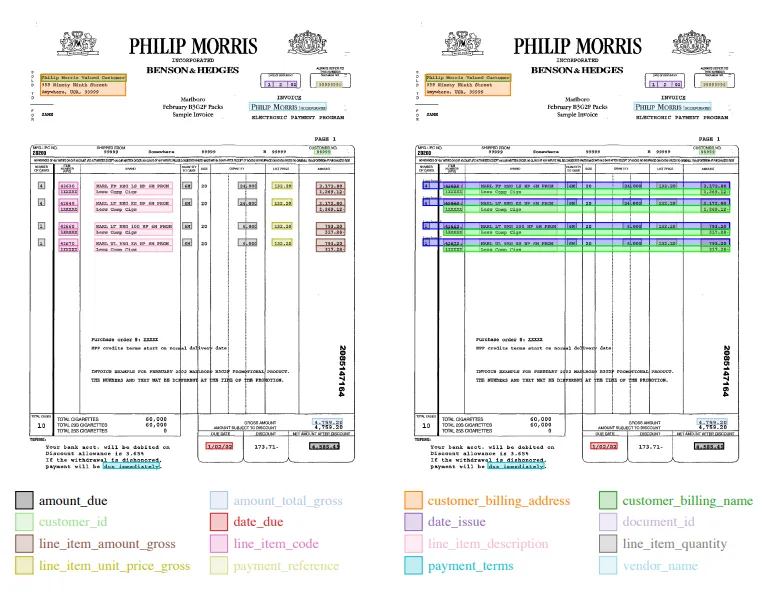
Annotated fields and line items
Cost is summed per document from each provider's published token rate or, for the document extraction provider, from reported credits converted at the published credit price.
06 Results
Across the 500-document evaluation, xMentium produced the highest outcome-weighted score. It also produced the largest raw match count and fewer extra values than the next-ranked systems.
| Rank | Provider | Match | Near | Wrong | Missed | Extra | F | Cost |
|---|---|---|---|---|---|---|---|---|
| 1 | xMentium | 9,448 | 1,087 | 1,016 | 2,796 | 2,852 | 75.0 | $17.93 |
| 2 | Document extraction provider | 9,315 | 1,157 | 1,156 | 2,719 | 4,664 | 69.9 | $37.26 |
| 3 | OpenAI Terra | 8,532 | 1,045 | 828 | 3,942 | 3,101 | 69.7 | $14.38 |
| 4 | OpenAI Sol | 8,558 | 1,033 | 974 | 3,782 | 4,123 | 67.1 | $34.37 |
| 5 | OpenAI Luna | 8,624 | 1,070 | 1,013 | 3,640 | 4,968 | 65.6 | $6.71 |
| 6 | Anthropic Sonnet 5 | 7,931 | 1,094 | 1,022 | 4,300 | 4,691 | 62.9 | $10.31 |
| 7 | Gemini 3 Pro | 8,172 | 1,001 | 906 | 4,213 | 5,202 | 62.7 | $19.03 |
| 8 | OpenAI GPT-5 mini | 8,529 | 1,168 | 1,150 | 3,500 | 6,768 | 61.5 | $3.34 |
| 9 | OpenAI GPT-5 | 7,168 | 1,117 | 993 | 5,069 | 3,692 | 61.3 | $22.77 |
| 10 | Gemini 2.5 Flash | 7,455 | 1,056 | 1,080 | 3,720 | 5,827 | 60.0 | $3.66 |
| 11 | Gemini 2.5 Pro | 7,799 | 1,050 | 1,160 | 3,280 | 7,367 | 58.5 | $17.20 |
| 12 | Gemini 3 Flash | 6,920 | 1,007 | 1,035 | 4,552 | 6,158 | 55.8 | $5.87 |
| 13 | Gemini 3.7 Flash | 6,307 | 881 | 898 | 5,920 | 4,086 | 55.3 | $1.78 |
| 14 | NVIDIA Nemotron Parse + Nano Omni | 7,353 | 949 | 1,124 | 3,768 | 10,657 | 50.2 | $2.30 |
| 15 | NVIDIA Nemotron 3 Nano Omni | 8,784 | 1,114 | 1,353 | 2,847 | 14,770 | 49.6 | $2.04 |
| 16 | Anthropic Opus 5 | 2,324 | 393 | 426 | 11,204 | 6,472 | 21.8 | $51.78 |
07 Degradation Experiment
We also evaluated a deterministic 100-document subset under medium image degradation. The subset was stratified by document type, source, cluster tier, and layout cluster. Each page was rendered at 100 DPI, randomly rotated within +/-2.5 degrees, blurred with a Gaussian radius of 1.0, perturbed with additive noise, and recompressed at JPEG quality 30. All systems were scored against the same unchanged answer keys.
| Rank | Provider / model | Match | Near | Wrong | Missed | Extra | F (%) | Cost |
|---|---|---|---|---|---|---|---|---|
| 1 | xMentium complete-pipeline | 1,491 | 248 | 308 | 641 | 623 | 67.3 | $3.60† |
| 2 | OpenAI gpt-5.6-sol | 1,203 | 208 | 254 | 1,023 | 639 | 57.7 | $7.16 |
| 3 | Google Gemini 2.5 Pro | 1,409 | 277 | 242 | 760 | 1,320 | 57.1 | $3.60 |
| 4 | Document extraction provider (default) | 1,284 | 289 | 290 | 825 | 1,086 | 56.5 | $2.15* |
| 5 | OpenAI gpt-5.6-luna | 1,189 | 228 | 307 | 964 | 806 | 55.6 | $1.51 |
| 6 | OpenAI gpt-5.6-terra | 1,090 | 211 | 246 | 1,141 | 559 | 55.1 | $3.34 |
| 7 | OpenAI gpt-5-mini | 1,026 | 228 | 238 | 1,196 | 647 | 52.3 | $0.57 |
| 8 | Google Gemini 2.5 Flash | 1,198 | 216 | 330 | 870 | 1,194 | 52.2 | $0.82 |
| 9 | OpenAI gpt-5 | 738 | 185 | 175 | 1,590 | 420 | 43.2 | $3.82 |
| 10 | Anthropic Claude Sonnet 5 | 759 | 125 | 128 | 1,676 | 819 | 38.5 | $1.76 |
| 11 | Anthropic Claude Opus 5 | 510 | 76 | 89 | 1,982 | 1,400 | 24.0 | $9.12 |
Cost derived from published token rates; * Document extraction provider cost derived as credits × $0.015. † xMentium cost extrapolated from the full 500-document metered pipeline cost.
08 Limitations and Future Work
DocILE is a useful public benchmark because it is large, annotated, schema-stable, and layout-diverse. It remains a business-document benchmark. The next research question is whether the same pipeline design continues to dominate on more visually complex, domain-specific document families.
The headline table reports the outcome-weighted field extraction score used in this evaluation. It should be read separately from official DocILE localization metrics.
DocILE primarily evaluates business documents such as tax invoices, orders, and receipts. It does not represent diagram-heavy engineering corpora such as P&IDs.
The degradation experiment uses deterministic image transformations. It is a controlled robustness test, not a complete model of real scanner, fax, handwriting, or capture artifacts.
Next evaluations should extend beyond invoice-like documents to annotated engineering diagrams, P&IDs, and customer-specific corpora with independently constructed answer keys.
Adding business rules improved performance across the evaluated models. xMentium came out on top because those rules worked across its complete pipeline, combining domain knowledge with OCR repair, structured extraction, and normalization. The result reflects how effectively the pipeline puts business rules to work alongside the underlying models.
Additional work should evaluate arithmetic cross-checks, field-level confidence calibration, and model routing policies that preserve accuracy while reducing cost.